Buyer's Guide
Best School Management Software in Pakistan: A 2026 Buyer's Guide
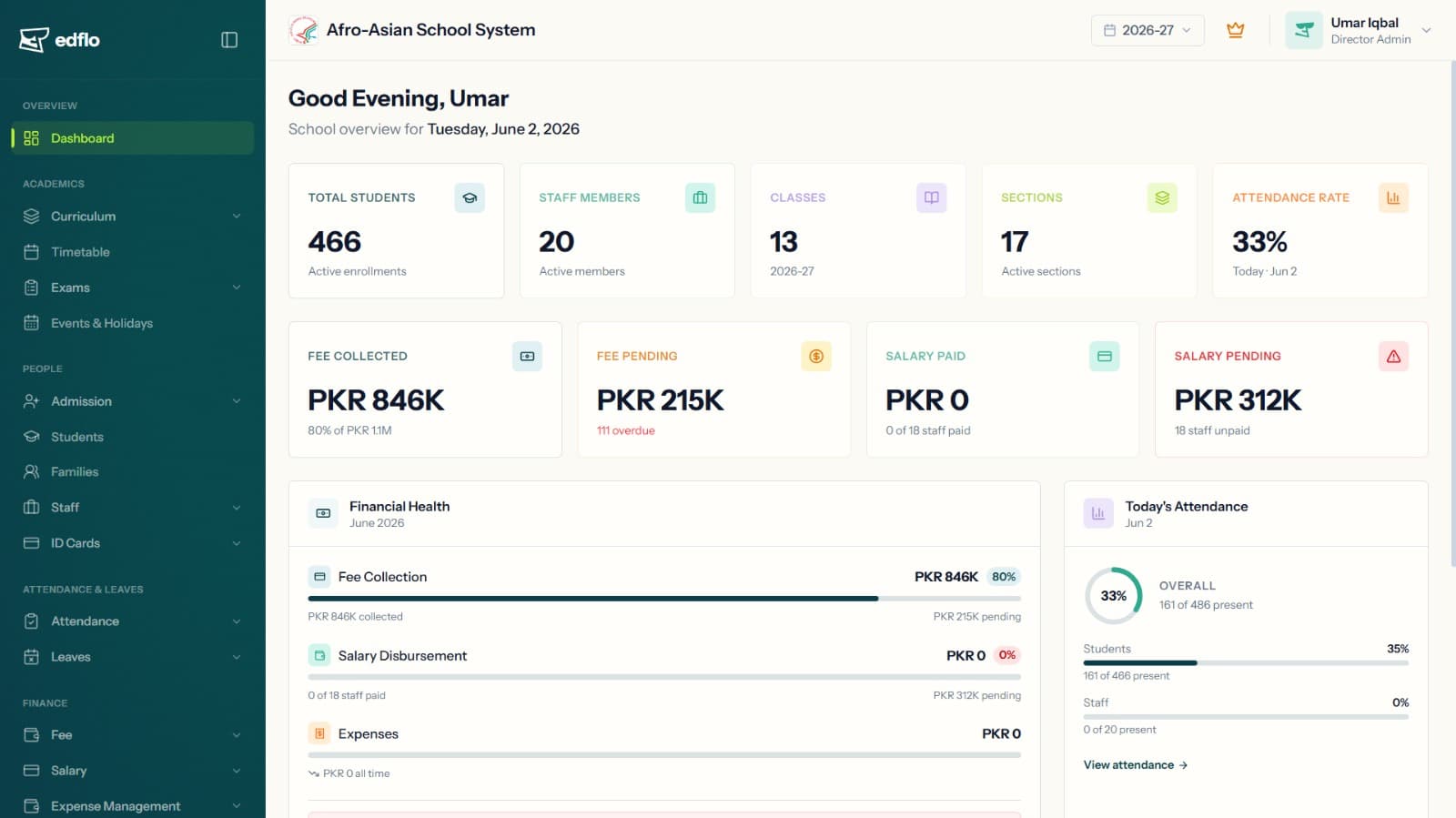
Choosing school management software is one of the highest-leverage decisions a school in Pakistan can make. The right system saves your team hundreds of hours a year, improves fee collection, and keeps parents engaged. The wrong one becomes expensive shelfware. This guide walks you through exactly how to evaluate your options in 2026 — the features that matter, the questions to ask vendors, and how to roll it out without disrupting your school.
What is school management software?
School management software — sometimes called a school management system (SMS), school ERP, or student information system (SIS) — is a single platform that runs your school's day-to-day operations. Instead of separate registers, spreadsheets and WhatsApp groups, everything lives in one connected system.
A modern platform covers attendance, fee collection, academics and report cards, HR and payroll, parent communication, and analytics. Because the modules share data, work flows automatically: marking attendance triggers a parent alert, and a fee payment instantly produces a receipt and updates your collection dashboard.
The features that actually matter
It's easy to be impressed by long feature lists. In practice, a handful of capabilities drive almost all of the value for Pakistani schools. Prioritise these:
1. Fee management built for Pakistan
Fee collection is where schools feel the most pain — and where good software pays for itself fastest. Look for automated monthly challan generation, reminders over WhatsApp and SMS, instant digital receipts, and a live dashboard that shows exactly who has paid and who hasn't.
2. Fast, mobile attendance
Teachers should be able to mark a whole class in one tap from their phone, with parents alerted automatically the moment a child is absent. If marking attendance is slow, teachers won't use it consistently and your data will be unreliable.
3. Parent communication parents actually see
A dedicated parent app is valuable, but in Pakistan, WhatsApp and SMS are essential. The best systems push announcements, attendance and fee alerts through the channels families already check every day.
4. Digital report cards and exam management
Look for one-click report card generation, custom grading schemes, and performance trends — so exam season stops being a paperwork marathon.
5. Multi-branch support (if you have campuses)
If you run more than one campus, you need a unified dashboard across branches with branch-level controls — otherwise consolidating reports becomes a monthly fire drill.
Questions to ask before you buy
- Is there a free trial, and how long is it? (A genuine trial lets you test with real data before committing.)
- Do you migrate our existing data — from spreadsheets, paper or other software — for free?
- How long does onboarding take, and do you train our staff?
- Are WhatsApp and SMS alerts included, and how are they priced?
- How is our data secured and backed up, and what is your uptime guarantee?
- Can the system grow with us — more students, more branches, a branded app?
- What support do we get after going live, and is it local?
How much should it cost?
Most school management software in Pakistan is priced per student or per school, often as a tailored quote rather than a public price. That's normal — your cost depends on your number of students, the modules you need, and add-ons like WhatsApp alerts or a custom-branded app.
Rather than fixating on the lowest sticker price, weigh the return: hours saved every month, higher and faster fee collection, and fewer defaulters typically dwarf the subscription cost. Ask each vendor for a clear quote against your actual student numbers, and start with a free trial so you can see the value before you pay.
How to roll it out without disruption
The biggest fear schools have is switching mid-year. A good vendor removes that risk. Expect them to migrate your data, configure your classes and fee structure, and train your staff — with most schools going live within three to five days.
Start with the modules that deliver immediate value (attendance and fees), get teachers and the accounts office comfortable, then expand into academics, HR and analytics. Communicate the change to parents early, and lean on the vendor's onboarding team rather than trying to do it all yourself.
Why schools choose EdFlo
EdFlo is an all-in-one school management system built specifically for Pakistani schools. It combines attendance, fee collection, academics, HR and payroll, communication and analytics in one platform — with a parent app plus WhatsApp and SMS alerts that families actually read.
Schools start with a 40-day free trial (no credit card), get free data migration and hands-on onboarding, and can scale from a single campus to a multi-branch chain — or add their own custom-branded app. It's designed to deliver the outcomes this guide describes: hours saved, stronger collection, and happier parents.
Key takeaways
- Prioritise fee management, mobile attendance and WhatsApp/SMS communication — they drive most of the value.
- Insist on a real free trial, free data migration and hands-on onboarding.
- Judge cost by return (hours saved, collection gains), not just sticker price.
- Roll out attendance and fees first, then expand — most schools go live in 3–5 days.
Frequently asked questions
What is the best school management software in Pakistan?
The best system is the one that fits your school's size and pain points. Prioritise fee management, fast mobile attendance, and WhatsApp/SMS communication, then insist on a free trial, free data migration and local support. EdFlo is an all-in-one option built specifically for Pakistani schools.
How much does school management software cost in Pakistan?
Pricing is usually tailored to your number of students and the modules you need, rather than a fixed public price. Weigh the cost against the return — hours saved and improved fee collection — and start with a free trial to see the value first.
How long does it take to switch systems?
With a good vendor that handles data migration and staff training, most schools go live within three to five days, even mid-year.